At the intersection of reporting completeness and avoiding wordiness stood the JAMA Network figure title. For years, the directive against naming the figure type in the figure title has been a core tenet of figure editing. An editor could sit back with satisfaction (but not too long, given the deadline-based environment) knowing that the omission satisfied the itch to adhere to the recommended count of 10 to 15 words and the convention of treating a figure as a self-explanatory visual element.
That all changed in 2025.
What could supplant word count and traditional principles in the heart of an editor? The reasons for the change are so forthright that it’s a wonder we did not revise guidance until now.
Not everyone grasps things the same way, so inclusion of the figure type can aid in reader interpretation. To navigate searches in the internet wilderness, inclusion of the figure type can assist in getting specific online search results. To increase accessibility, inclusion of the figure type can help those who use assistive technology such as screen readers.
Several published examples show this guidance in action.
Flow diagram
Heat map
Forest plots
Kaplan-Meier curves
Dot plots
Illustration
As in many JAMA Network conventions, modifications must be made based on context. The addition of figure type may not be automatically pluggable into every title. Consider figures with multiple images or panels. If inclusion of a figure type in the title is not feasible due to complexity of presentation, then the figure type should be named in the caption.
Whereas the intersection of reporting completeness and assumed visual completeness was bounded by limits, this evolution in reporting places figure titles at a new intersection characterized by expansion: figure titles now occupy the junction of reporting completeness and service to all readers.
When titling scientific articles, context matters, clarity takes precedence over creativity, and concision is key.
Studies have shown that shorter titles amass more citations and article downloads. In one study by Letchford et al,1 the authors examined the top 20 000 most-cited articles from 2010, finding that those with shorter titles were more frequently cited. They also assessed title length and citations for individual journals, and the results were similar—shorter titles garnered more citations.
In another study by Jamali et al,2 they showed that articles with shorter titles were downloaded more often, and titles formatted with a colon followed by a subtitle were generally longer and less frequently downloaded and cited.
First, The Basic Title Formula
The good news is that research article titles can adhere to a near-universal format that emphasizes specificity, concision, and clarity. Titles should be easily and quickly understood by individuals scanning the literature for what to read. The following basic formula for titles of research articles can be followed:
“[The key variable(s) measured] + [In or among the individuals and or condition studied]”
Length Guidance
Aligned with the research on title lengths,1,2 manuscript editors at the JAMA Network use character count guidelines based on article type. For research articles, we aim for the main title to be no more than 100 characters with spaces, and for opinion or clinical education articles, no more than 60 characters with spaces.
One way to easily shorten titles is skipping the oft automatic insertion “Association of” or “Effect of” at the beginning of a title.
Also, if not integral to the crux of the study, the comparator variable may be omitted in randomized clinical trial titles. Here are a few published examples of titles with and without comparators:
In the title “First-Line Sugemalimab Plus Chemotherapy for Advanced Gastric Cancer: The GEMSTONE-303 Randomized Clinical Trial,”3 the reader can infer the research compares the immunotherapy drug sugemalimab plus chemotherapy to chemotherapy alone without adding the unnecessary words “Compared to Chemotherapy Alone.”
In the title “Multivitamins After Myocardial Infarction in Patients With Diabetes: A Randomized Clinical Trial,”4 there is no need to state that the comparator is placebo. It can be inferred.
In the title “Chlorhexidine vs Routine Foot Washing to Prevent Diabetic Foot Ulcers: A Randomized Clinical Trial,”5 both variables are necessary to understand what the trial investigated.
What to Avoid
The purpose of a title is to draw the reader in and make them want to read your article, so best practice is to not reveal the study results in the title.
What’s more, study results are often more nuanced than what is expressed in a single phrase. Therefore, declarative statements, such as “X is associated with Y,” are best avoided in journal article titles.
Additionally, using a question to title a report of research evokes uncertainty, which can send science-minded readers searching for solid evidence looking elsewhere. “Is Television Viewing Associated With Social Isolation?” might be edited to “Television Viewing and Social Isolation Among Adolescents” to draw in readers.
Authors and editors may also omit location(s) and year(s) in titles unless they are germane to the study objective. In most cases, including the location(s) and study dates in the abstract and methods section will suffice.
A Note on Subtitles
As a rule, an article’s main point should be understood through the main title without reading the subtitle. It is possible that only the main title appears in a Google search result, depending on a given journal’s digital practices.
Furthermore, when scanning database search results or reference lists, readers may focus their attention on main titles. Thus, “Psychiatric Disorders: A Rural-Urban Comparison” might work better as “Psychiatric Disorder Prevalence in Rural vs Urban Settings.” If readers come across or quickly scan the main title only (“Psychiatric Disorders”), they will not have enough information to know what the study is about.
In general, observational studies should avoid subtitles. However, in clinical trials and review articles, the subtitles “A Randomized Clinical Trial” or “A Meta-Analysis” quickly indicate the level of evidence or type of analysis involved in the study, which can be helpful to readers sifting through studies.
Specific study names, such as “The KEYNOTE-062 Randomized Clinical Trial,” are also acceptable in subtitles because they enable readers to recognize specific trials or research groups more easily, which is especially important when the research is pivotal.
Identifying and Prioritizing Keywords
Finally, now more than ever, editors should consider search engine optimization (SEO), a strategy for crafting digital copy that will appear higher in search results, when reviewing and revising titles. A keen editor has an eye for keywords, potentially using tools, such as Google Trends, to identify frequently searched terms.6
As medical editors, we need to think about meeting readers where they are, not only major search engines like Google but also peer-reviewed literature databases like PubMed. It can be helpful for editors to put themselves in the readers’ shoes, thinking, “If I [the reader] want to know about X, I will most likely type Y into a search bar.” This ensures that any edits you make to titles will be fair to the author and the reader.
References
Letchford A, Moat HS, Preis T. The advantage of short paper titles. R Soc Open Sci. 2015;2(8):150266. doi:10.1098/rsos.150266
Jamali HR, Nikzad M. Article title type and its relation with the number of downloads and citations. Scientometrics. 2011;88:653-661. doi:10.1007/s11192-011-0412-z
Zhang X, Wang J, Wang G, et al. First-line sugemalimab plus chemotherapy for advanced gastric cancer: the GEMSTONE-303 randomized clinical trial. JAMA. Published online February 24, 2025. doi:10.1001/jama.2024.28463
Ujueta F, Lamas GA, Anstrom KJ, et al. Multivitamins after myocardial infarction in patients with diabetes: a randomized clinical trial. JAMA Intern Med. Published online March 3, 2025. doi:10.1001/jamainternmed.2024.8408
Lydecker AD, Kim JJ, Robinson GL, et al. Chlorhexidine vs routine foot washing to prevent diabetic foot ulcers: a randomized clinical trial. JAMA Netw Open. 2025;8(2):e2460087. Published 2025 Feb 3. doi:10.1001/jamanetworkopen.2024.60087
Google Trends. Accessed March 7, 2025. https://trends.google.com/trends/
If you’re reading about the friends of d’Artagnan, it’s The Three Musketeers.
Given that JAMA Network publications are technical instead of literary (A Piece of My Mind and Poetry notwithstanding), we would fall on the candy side of the divide between using numerals and using words (whether candy is technical is a discussion for another day).
The online abstract to Chapter 18.0 in the AMA Manual of Style, Numbers and Percentages, raises “the difficult question of when to use numerals and when to use words, and how to combine the two.” Note the tidy example of spelling a number as a noun. This difficulty is a factor in what I see as numeral inflation in the form of encroaching “1” use.
One of the most obvious places for numeral use is in identifying study populations.
For example, take this hypothetical Delphi consensus group: 5 physicians, 4 nurse practitioners, 3 patient advocates, 2 patient caregivers, and 1 health system leader.
One of the most obvious places for spelled number use is in idiomatic phrasing or in parts of speech. Section 18.2.3, Accepted Usage, advises using words “in circumstances in which use of the numeral would place an unintended emphasis on precise quantity.” When a number appears in text, what is the cutoff point between intended and unintended emphasis?
The manual suggests that “common sense” plays a role in editorial judgment, but one person’s “common sense” is another person’s “thanks anyway.”
As examples of avoiding unintended emphasis on quantity, the style manual lists “one-time variables,” “in one recent case,” and “has become one of the dominant topics.” However, in current publications you will find encroaching “1” use in various “1-time” constructions, the phrase “in 1 recent analysis,” and the wording “has become 1 of the leading reasons.”
How about these uses of encroaching 1?
“At least 1 moderate event.”
“In 1 large health system.”
“More than 1 time zone.”
Numeral use would seem to be justified by the idea that a moderate event, a large heath system, and a time zone are being counted.
Section 18.2.2 advises that we should spell “one” used as a pronoun or a noun, and these 1s are part of a noun phrase as the object of the prepositions “at least,” “in,” and “more than.”
I am “all for one.” It can be a relief to have an automatic edit to make in the name of upholding style, but many of us are not “one for all”—even in cases sanctioned by Accepted Usage. Not every “one” that seems countable should be “1,” and I offer this observation not to get editors into the weeds (an occupational hazard) but rather to help them avoid reflexive editing.
The short answer is yes, but with a caveat: transparency is key. It is no secret that generative artificial intelligence (AI) models can create various types of content, including text, images, audio, and video. However, people’s feelings about using these tools in scientific research are mixed, with some academics showing concern and others embracing the new technology.
Regardless of personal opinion, people are using these tools—a 2023 Nature survey of more than 1600 scientists reported that nearly 30% reported using generative AI tools to assist with writing manuscripts.1 As 2023 began, many research articles already listed the generative AI tool ChatGPT as an author.2 By October of the same year, 87 of the 100 highest-ranked scientific journals saw the need to publish online guidance for authors on generative AI use for content creation at their publications.3
JAMA and the specialty journals in the JAMA Network were among those that provided online guidance, encouraging authors, reviewers, and editors to be transparent, responsible, and follow AI best practices in medical and scientific publishing. Importantly, the guidelines noted that “nonhuman artificial intelligence, language models, machine learning, or similar technologies do not qualify for authorship.”4 More information on ethical and legal considerations can be found in chapter 5.1.12 of the AMA Manual of Style.
If authors choose to use AI tools to create content or assist with manuscript creation, they must disclose such use in the Methods or Acknowledgements section of the article. The following example, found in chapter 3.15.13 of the AMA Manual of Style, can be used as an acknowledgment for an article that uses generative AI:
“The authors acknowledge using ChatGPT (GPT-3.5, OpenAI) for text editing to improve the fluency of the English language in the preparation of this manuscript on September 15, 2023. The authors affirm that the original intent and meaning of the content remain unaltered during editing and that ChatGPT had no involvement in shaping the intellectual content of this work. The authors assume full responsibility for upholding the integrity of the content presented in this manuscript.“
As presented in this example, the following information must be included in the disclosure of AI use for content generation:
Name of the AI software platform, program, or tool;
Version and extension numbers;
Manufacturer;
Date(s) of use; and
A brief description of how the AI was used and on what portions of the manuscript or content.
In addition to the above considerations, authors should provide the following additional information if AI was used in the study:
Prompt(s) used, their sequence, and any revisions;
Institutional review board/ethics review, approval, waiver, or exemption;
Methods or analyses included to address and manage AI-related bias and inaccuracy of AI-generated content; and
Adherence to a relevant reporting guideline if followed.
These guidelines emphasize accountability and human oversight when AI is used in medical publishing. To assist authors with adhering to new policies regarding AI, the JAMA Network’s automated manuscript submission system asks all authors whether AI was used for content creation.5 If AI tools were used to generate creative content (noncreative content, such as basic grammar and spelling checks, does not need to be disclosed), authors must provide specific information about their use and take responsibility for the integrity of the AI tools’ outputs.
JAMA Network authors are also asked to be aware of inputting identifiable patient information into an AI model, as well as potential copyright and intellectual property concerns. Limitations of AI tools should be included in an article’s Discussion section, including potential inaccuracies or biases, and, ideally, how these have been managed by the authors.
The JAMA Network also encourages authors to consult relevant EQUATOR guidelines (https://www.equator-network.org) depending on the type of study and AI use,4 including the following:
Reporting guidelines for clinical trial reports for interventions involving artificial intelligence (CONSORT-AI);
Guidelines for clinical trial protocols for interventions involving artificial intelligence (SPIRIT-AI);
Minimum information about clinical artificial intelligence modeling (MI-CLAIM);
Checklist for Artificial Intelligence in Medical Imaging (CLAIM);
MINimum Information for Medical AI Reporting (MINIMAR) for developing reporting standards for AI in health care; and
Updated guidance for reporting clinical prediction models that use regression or machine learning methods (TRIPOD-AI).
At the time of writing this blog post, several reporting guidelines are under development by the EQUATOR Network, including the following:
Preferred Reporting Items for Systematic Reviews and Meta-Analyses – Artificial Intelligence Extension (PRISMA-AI);
As AI tools continue to gain momentum and develop rapidly, editorial leaders of scientific journals are wise to guide the responsible use of such tools. This guidance may—and likely will—evolve over time. Like other publishers, the JAMA Network has moved expediently to publish AI usage guidelines. As is true for the journal’s other style rules, authors who publish in JAMA and the JAMA Network specialty journals will be guided to follow these guidelines into the future.
References
Van Noorden R, Perkel JM. AI and science: what 1,600 researchers think. Nature. 2023;621(7980):672-675. doi:10.1038/d41586-023-02980-0
Mazzoleni S, Ambrosino N. How artificial intelligence is changing scientific publishing—unrequested advice for young researchers II. Pulmonology. 2024;30(5):413-415. doi:10.1016/j.pulmoe.2024.04.011
Ganjavi C, Eppler MB, Pekcan A, et al. Publishers’ and journals’ instructions to authors on use of generative artificial intelligence in academic and scientific publishing: bibliometric analysis. BMJ. 2024;384:e077192. doi:10.1136/bmj-2023-077192
Flanagin A, Bibbins-Domingo K, Berkwits M, Christiansen SL. Nonhuman “authors” and implications for the integrity of scientific publication and medical knowledge. JAMA. 2023;329(8):637-639. doi: 10.1001/jama.2023.1344
Flanagin A, Kendall-Taylor J, Bibbins-Domingo K. Guidance for authors, peer reviewers, and editors on use of AI, language models, and chatbots. JAMA. 2023;330(8):702-703. doi:10.1001/jama.2023.12500
An upset Japanese entrepreneur reading something on her laptop while missing some deadline. She is sitting at her office desk.
Earlier this year, several small updates were made to the AMA Manual of Style that clarified some lingering questions that had left some editors potentially perplexed (or perhaps possibly puzzled!).
To Repeat or Not to Repeat?
The debate between the use of repeat vs repeated is no longer an existential crisis worthy of a Danish prince. Chapter 11.1 has been updated to indicate that these terms can be used interchangeably (just like Rosencranz and Guildenstern).
Game, Dataset, Match
One author serves up data in a data set. Another author swings their racket, sending data across the court in a dataset. So who won?
According to Chapter 11.3, author 2 can celebrate with strawberries and cream: dataset is now the preferred spelling.
A Sensitive Matter
To differentiate high-sensitivity troponin T from contemporary assays, it is now being reported in ng/L, which has been updated accordingly in chapter 17.5.
So please add these changes to the Homerian catalog already in your editor’s mind, as we know the evolution of style changes is always an odyssey!
Husband comforting his sick wife at home. Receiving bad news.
Although often regularly used in the past, the term committed suicide may imply that the act of suicide is criminal or morally wrong.1
Likewise, referring to a suicide attempt as a “success” or “failure” implies that “the person who died by suicide has accomplished or not accomplished (a failure) the act of suicide”1 or that death was a favorable outcome.2
Factual and judgment-free language is preferred.1 Language that is careful not to stigmatize suicide, suicidal behavior, or mental health issues3 should always be used. For that reason, terms such as died by suicide or suicide attempt should be used. Such terms contribute to destigmatizing suicide.2
The term suicide should also not be used out of context (eg, “political suicide”) because this may desensitize readers to the term2 or seem insensitive.
Person-first language, which aligns with existing AMA Manual of Style guidelines (chapter 11.12.6), should be used (eg, “person who attempted suicide” instead of “suicide attempter” or “person with suicidal ideation” instead of “suicidal person”).
Avoid:
Committed or completed suicide
Unsuccessful or successful suicide attempt
Failed suicide attempt
Suicide epidemic
Killed themself
Took their own life
Ended their life
Preferred:
Died by suicide
Death by suicide
Suicide death
Suicide attempt
Fatal suicide behavior
Person with suicidal ideation
The term “intentional self-harm” should not be used interchangeably with “suicide attempts.”
The designation “nonalcoholic fatty liver disease (NAFLD)” is no longer accepted across JAMA and the JAMA Network journals, except to reflect the language used in data collection for a study (or search terms for a review).
The directive is based on the recommendations of the American Association for the Study of Liver Diseases and the European Association for the Study of the Liver, as well as the Latin American Association for the Study of the Liver.
In collaboration with hepatologists, gastroenterologists, pediatricians, endocrinologists, hepatopathologists, public health and obesity experts, colleagues from industry, regulatory agencies, and patient advocacy organizations, a consensus was developed via the Delphi process for a change in nomenclature.1
The term chosen to replace NAFLD is “metabolic dysfunction–associated steatotic liver disease (MASLD).” In the previous designation, the term nonalcoholic may have been confusing for patients and physicians. The word fatty also has stigmatizing and negative connotations.
The same committee process resulted in another designation change that will be implemented across JAMA and the JAMA Network journals. The designation “nonalcoholic steatohepatitis (NASH)” is now called “metabolic dysfunction–associated steatohepatitis (MASH)” to avoid trivializing the diseases or confusing patients with the possible connotations of the term nonalcoholic.2
It is hoped that these updates will clarify what the diseases are instead of what they are not.
The AMA Manual of Style has added these abbreviations and expansions to the list of clinical terms in chapter 13.11.
References
Rinella ME, Lazarus JV, Ratziu V, et al. A multisociety Delphi consensus statement on new fatty liver disease nomenclature. Hepatology. 2023;78:1966-1986.
Eskridge W, Cryer DR, Schattenberg JM, et al. Metabolic dysfunction–associated steatotic liver disease and metabolic dysfunction–associated steatohepatitis: the patient and physician perspective. J Clin Med. 2023;12(19):6216.
The previous recommendation against its use in this way had sparked debate among grammarians and language enthusiasts, some of whom argued that it should only be used as an adjective phrase modifying a noun.
The relaxation of grammar rules, such as the new guidance on because of vs due to, can positively and negatively affect language depending on the context in which it is used. While it can increase flexibility for writers and make the language more accessible to nonnative speakers, it may also reduce clarity and consistency in some cases. Thus, the creation of official guidance in the AMA Manual of Style is crucial.
The etymology of because of and due to is also worth exploring.2Because was modeled on the French par cause and has been used with the word of since the late 14th century.
On the other hand, due is from old French deu, past participle of devoir, meaning “to owe.” Due to came about in the early 15th century as “deserved by, merited by,” and its use as a prepositional phrase dates back to 1897.
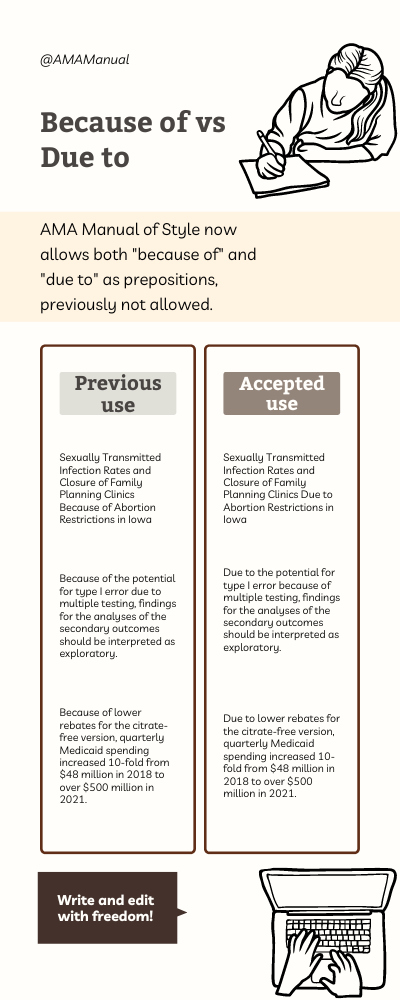
Current guidance now indicates that because of, caused by, due to, and owing to are acceptable to use as prepositions without restriction.
To illustrate the use of due to in medical writing, below are examples from various JAMA Network articles in which the phrase can now be used interchangeably with because of as a prepositional phrase.
The acceptance of due to as a prepositional phrase by the AMA Manual of Style is a notable milestone in the ongoing debate over its use. It provides greater flexibility for writers and editors while ensuring consistency and clarity in medical writing and other communication formats that follow AMA style.
The AMA Manual of Style now accepts “due to” as a prepositional phrase, which impacts authors and medical editors.
The debate over “due to” was sparked by its previous disallowance in many instances; some argued for its limited role.
Relaxed grammar rules can enhance flexibility and accessibility, but may compromise clarity; this highlights the significance of AMA accepting this change.
References
Frey T, Young RK. Correct and preferred usage. In: Christiansen S, Iverson C, Flanagin A, et al. AMA Manual of Style: A Guide for Authors and Editors. 11th ed. Oxford University Press; 2020. Accessed February 17, 2023. https://doi.org/10.1093/jama/9780190246556.003.0011
Online etymology dictionary. Accessed February 17, 2023. https://www.etymonline.com/
Srinivas M, Wong NS, Wallace R, et al. Sexually transmitted infection rates and closure of family planning clinics because of abortion restrictions in iowa. JAMA Netw Open. 2022;5(10):e2239063. Published October 3, 2022. doi:10.1001/jamanetworkopen.2022.39063
Martinez FJ, Han MK, Lopez C, et al. Discriminative accuracy of the CAPTURE tool for identifying chronic obstructive pulmonary disease in US primary care settings. JAMA. 2023;329(6):490-501. doi:10.1001/jama.2023.0128
Wang J, Lee CC, Kesselheim AS, Rome BN. Estimated Medicaid spending on original and citrate-free adalimumab from 2014 through 2021. JAMA Intern Med. 2023;183(3):275-276. doi:10.1001/jamainternmed.2022.6299
Part of the purpose of the AMA Style Insider is to report on changes made in the AMA Manual of Style that aim to improve not only the editing process but also advance ethics and equity in medical publishing. Changes are not made arbitrarily but as a result of many experts building consensus on what represents best practices, and they’re made to create a widespread standard.
However, the manual can only release these standards to the world–what requires more follow up is whether the changes are actually implemented in publishing and how successful they are in creating new standards.
This year, in JAMA Network Open, several JAMA Network editors and staff published a cross-sectional study1 that examined race and ethnicity reporting across 3 JAMA Network journals before (January to March 2019 and May to July 2021) and after (January to March 2022) the implementation of the Updated Guidance on the Reporting of Race and Ethnicity in Medical and Science Journals2 in August 2021 (which was based on revisions made to 11.12.3 of the style guide).
Among the key takeaways were that the number of articles that reported race and ethnicity information for study participants increased by 10.4% from 2019 to 2022, more articles reported participants’ age or sex and gender, and the number of articles that defined categories included in the term “other” increased 58.1% from 2019 to 2022.
Additionally, the number of articles that listed racial and ethnic group categories by alphabetical order increased by 75.9% between 2021 and 2022, and there was a 24.1% increase in the number of articles that defined how race and ethnicity were determined.
Although this study had limitations (which are clearly stated in the article) and more improvement is needed, these results seem encouraging that AMA Style Manual updates are not made just to alter the day-to-day of editors across medical publishing, but to potentially create real and lasting change.
References
Flanagin A, Cintron MY, Christiansen SL, et al. Comparison of reporting race and ethnicity in medical journals before and after implementation of reporting guidance, 2019-2022. JAMA Netw Open. 2023(6):e231706. doi:10.1001/jamanetworkopen.2023.1706
Flanagin A, Frey T, Christiansen SL, et al. Updated guidance on the reporting of race and ethnicity in medical and science journals. JAMA. 2021;326(7):621-627. doi:10.1001/jama.2021.13304
If your professional life requires adherence to AMA style, you may have gotten lost in the weeds styling hyphenated compounds in titles. No capitalization after a hyphen if a prefix or a suffix, if both parts are considered a single word (requiring a field trip to Merriam-Webster), if the compound is temporary, or if the parts do not carry equal weight.
I have long wondered how parts of a compound carry weight, which isn’t to say that I don’t like the idea. As a practical suggestion, though, it lacks a little, uh, practicality.
If you think of a compound as an entity on its own, any word that may carry weight because of its particular part of speech loses that identity (and drops the weight!) when it gets pulled into that magical realm of a hyphenated compound (all adjectives all the time). So “Short-term Effects” and “Full-time Coverage” have always read as weird to me, especially if they have appeared near “Early-Onset Disease.”
How fitting, then, that the AMA Manual of Style has finally addressed the weed problem with hyphenation. No need to kill them. We can just get them out of our way. Let the weeds live happy lives in some other organization’s style manual.
The new guidance in 10.2.2 reads “In titles, subtitles, and text headings, capitalize both parts of a hyphenated compound.” Hence, “Short-Term Effects” and “Full-Time Coverage.” Take a look in the online manual for more information and other new style guidance.
Now when you review capitalization in titles with hyphenated compounds to align with AMA style, you needn’t make excursions to other sources. You can stay in the AMA garden without getting lost in the weeds.